Software Delivery Is Changing Hands
by
Dmytro Miroshnychenko


by
Dmytro Miroshnychenko
Dmytro Miroshnychenko is the founder of Miros. IT Delivery, Project & Program Management expert, PMO builder with over 11 years of commercial experience with SMB & Global companies in software development.
Last updated:
Every 10-15 years, the software industry quietly rewrites how it builds software. We're in the middle of one of those rewrites right now. This is the biggest rewrite so far. Most companies haven't noticed yet.
Here's what's actually happening and why it matters more than the usual "AI will change everything" headline.
Three eras, one fundamental change
The story of software delivery is usually told as a story about speed. Waterfall was slow. Agile got faster. DevOps got faster still. AI will make us fastest of all.
That framing misses the point.
The real story is about who performs the work.
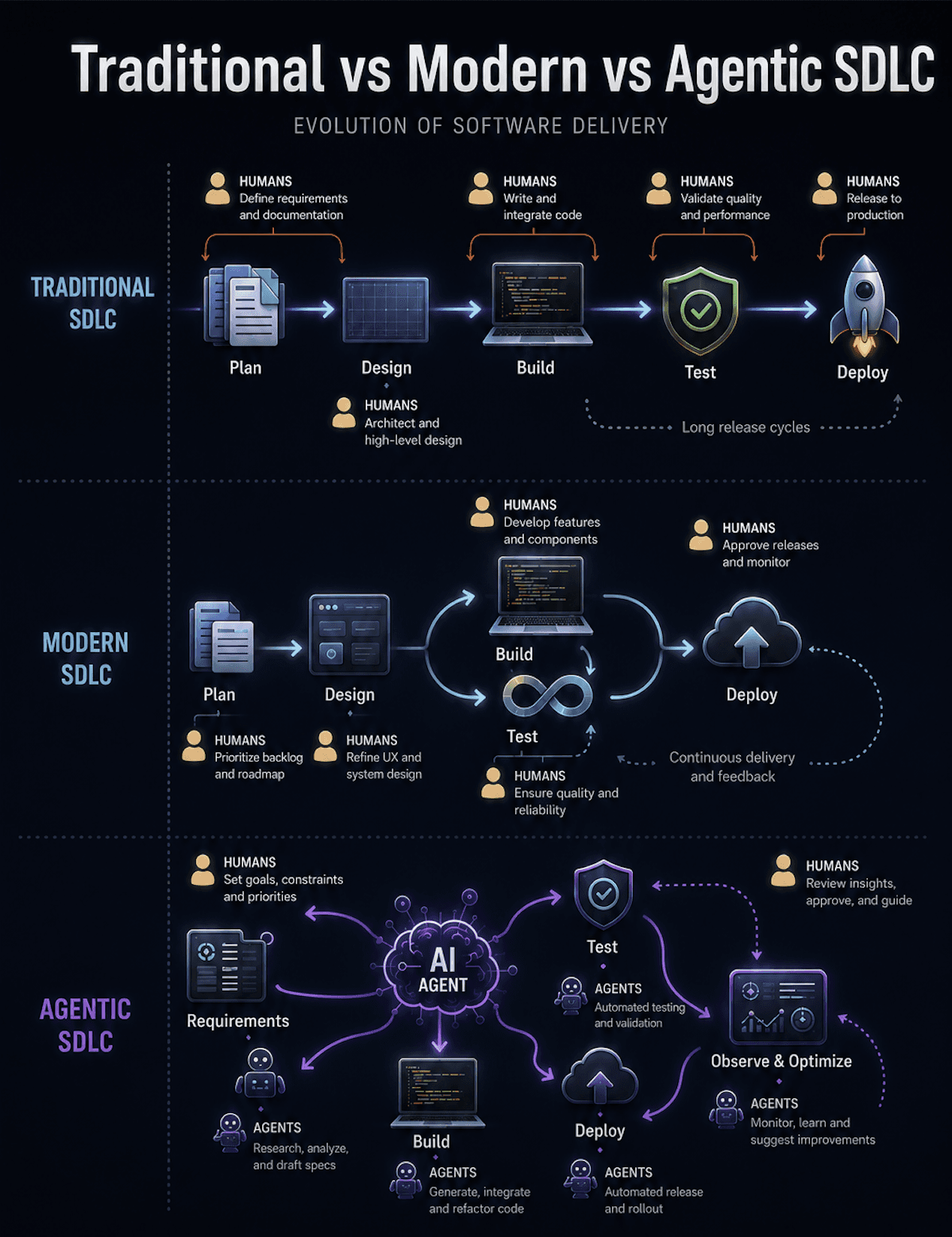
Traditional SDLC
It was built for predictability. Plan, design, build, test, deploy - linear, documented, governed by approvals. It worked when requirements rarely changed and software behaved more like infrastructure than a product. Humans executed every step. That was fine, because the world moved slowly enough to let them.
Modern SDLC
Agile plus DevOps - broke the linearity. Iterative delivery. CI/CD. Continuous feedback. Tighter loops between engineering and operations. A huge improvement. But the core execution model stayed the same: humans still wrote the code, designed the systems, fixed the bugs, ran the incidents. We automated workflows. We didn't replace execution.
Agentic SDLC
This isn't "AI helping developers write code faster." Copilots did that already. Agentic SDLC is something completelt different: AI systems executing most or substantial parts of the software lifecycle autonomously, under human supervision.
Same phases. Different operator.
Era | Who executes |
|---|---|
Traditional SDLC | Humans |
Modern SDLC | Humans + automation |
Agentic SDLC | AI agents (under human governance) |
That's the disruption. Not chat interfaces. Not autocomplete.
Execution ownership itself is moving.
What Changes?
Planning and requirements. Agents can analyze business context, generate structured specs, surface edge cases and map dependencies. This is why Spec-Driven Development is suddenly a serious discipline - agents need execution blueprints, not vague Slack threads.
The quality of your specifications becomes the ceiling on your autonomous throughput.
Design and architecture. Repository structures, service boundaries, infrastructure, security baselines, API scaffolding - all generated rapidly. What used to take weeks of senior engineering setup can land in hours. Experimentation gets cheap.
Greenfield gets faster than most leaders are prepared for.
Coding. Where everyone focuses, but only one layer of the shift. The real change is orchestration - multiple agents working across the stack in parallel, sharing context and goals.
Features, persistence, services, infra and docs generated together rather than sequentially.
Testing and QC. This is where things get interesting. Traditional QA assumes deterministic systems. Agents are probabilistic. Unit tests aren't enough. You need behavioral validation, scenario simulation, policy enforcement, runtime verification.
The teams getting this right are now building "harness" layers - governance environments that constrain and validate agent behavior before it touches production.
This will be one of the most important engineering disciplines of the next decade.
Deployment and operations. Multi-agent systems coordinating releases, handling rollback logic, monitoring health, responding to incidents.
A small, sharp team can suddenly produce throughput that used to require an org of hundreds.
Observation and optimization. Agents continuously learning from telemetry, logs, failures and customer behavior - then suggesting or implementing improvements without waiting for a human to file a ticket.
Self-improving delivery systems stop being a slide and start being a thing you run.
The new failure modes nobody is talking about enough
This is the part most companies underestimate.
Agentic systems are powerful. They're also dangerous if you deploy them carelessly.
Unsafe autonomy. An agent can produce technically correct output that causes serious business damage - deleting infrastructure, exposing data, mutating production dependencies, triggering irreversible actions. "It did exactly what I asked" is not a defense.
Semantic drift. Over long-running workflows, agents quietly misinterpret context. Multi-agent chains amplify it. By the time you notice, the assumptions baked into the system no longer match reality.
The verification tax. You can't test probabilistic systems the way you tested deterministic ones. You need governance layers, constrained execution environments, policy systems, approval gates, observability frameworks, validation harnesses. AI-native engineering isn't faster engineering. It's a different operational discipline.
If you're building agentic systems without a clear answer to these three, you're not running ahead of the curve. You're running toward a wall.
The human role isn't disappearing - it's moving up
There's a tired narrative that engineers vanish in this world. They don't.
What changes is what they spend their time on.
Keyboard-heavy execution gets automated. Strategic architecture, system governance, business alignment, AI orchestration, policy design, risk management, supervision - these become the high-leverage activities.
The most valuable engineers in the next decade are the ones who can design systems, orchestrate autonomous workflows, govern AI behavior and translate business intent into machine execution.
The pure execution layer is no longer where the leverage lives.This is uncomfortable for some people. It's also true.
What this means for your company
Most organizations aren't ready. Many are still trying to mature basic Agile or DevOps practices. Some are bolting copilots onto existing processes and calling it AI transformation.
That's not enough.
The companies that get this right early will run with radically lower operating costs, dramatically higher delivery velocity, smaller and more effective teams and faster experimentation cycles. The ones that ignore it become structurally slower than AI-native competitors and software history is brutal to slower operating models.
The window to get the foundations right is open now. It won't be open forever.
How Miros thinks about this
We work with companies designing AI-native delivery operating models, scalable PMO structures and autonomous execution systems for modern software businesses.
The pattern we see again and again: organizations don't fail at agentic adoption because the technology isn't ready. They fail because the operating model isn't ready.
If your team is exploring agentic workflows, AI-native engineering, or next-generation delivery operations - the right time to build the foundations is before the gap with AI-native competitors becomes hard to close.
That's the work we do.

Insights
Read more articles



Questions & answers
Frequently
Asked Questions
We already have PMs. Why would we need this?
Most companies we work with already have PMs. The issue is not the people - it’s the system they operate in. Without a clear delivery structure: - PMs work differently - priorities shift constantly - decisions are unclear - delivery becomes inconsistent What we implement is a single operating model: - how projects start & planned - how they are executed - how they are tracked - how decisions are made Your PMs don’t get replaced - they become effective inside a system that works.