The PM Isn't Disappearing with AI - It's Fragmenting
by
Dmytro Miroshnychenko

by
Dmytro Miroshnychenko
Dmytro Miroshnychenko is the founder of Miros. IT Delivery, Project & Program Management expert, PMO builder with over 11 years of commercial experience with SMB & Global companies in software development.
Last updated:
Every conversation about AI in software delivery eventually arrives at the same uncomfortable question: what happens to PMs?
The honest answer isn't "they get replaced." It's more interesting than that. The role is being pulled apart and redistributed - some of it to agents, some of it upward into strategic leadership, some of it sideways into engineering. What's left over is a much smaller, much more valuable job than the one most PMs do today.
Here's how it actually breaks down.
What agents absorb
A large part of traditional PM work is structurally exposed. If your week is mostly:
Updating Jira tickets
Running status meetings
Chasing people for updates
Writing repetitive reports
Manually coordinating dependencies
Copying requirements between systems
Tracking timelines in spreadsheets
…then most of that is already being absorbed by AI agents and orchestration systems. Sprint planning, backlog grooming, QA orchestration, release coordination, dependency mapping, risk detection, meeting summarization - these are increasingly handled by agents that don't sleep, don't forget and don't need a recurring 30-minute sync to share state.
This isn't a prediction. It's already starting. Outsourcing factories, low-margin software shops and reporting-heavy PMOs will feel it first. One strong AI-native delivery operator will quietly replace several coordinators.
That's the part everyone focuses on. It's also the least interesting part.
Where the rest of the role goes
The traditional PM job doesn't get vacuumed up by a single replacement. It splits across four directions.
1. AI agents take the coordination layer - the operational, repeatable, information-flow work that exists mostly because humans are bad at sharing state with each other.
2. Product leadership absorbs more of the "what should we build and why" question. In AI-native companies, product and delivery quietly merge. Small senior teams set direction; agents handle most of the implementation coordination. You already see this in elite startups.
3. Technical leadership gains more delivery influence. When AI writes the code, architecture quality, system boundaries, observability, eval systems and security constraints matter far more than manual task tracking. Tech leads and architects move closer to the steering wheel.
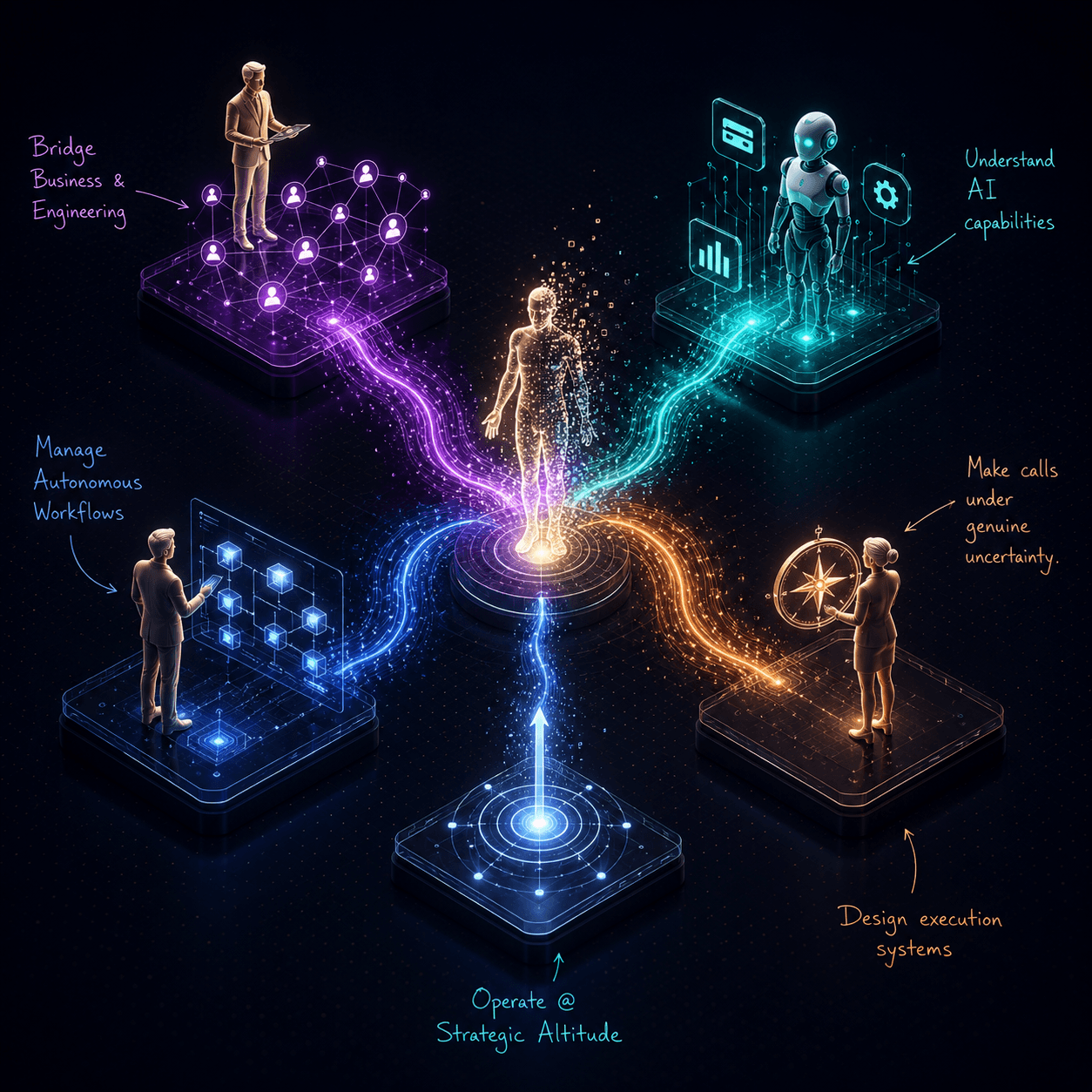
4. AI-native operations leaders - this is the upward evolution path for strong PMs. The work shifts from project tracking to execution system design: defining how human and AI workflows interact, setting governance, monitoring AI output quality, managing autonomous pipelines, aligning business intent with machine execution.
Less Jira. More systems thinking.
What this means for Agile
A lot of ceremonial Agile gets weaker in this world. Daily standups lose their purpose when agents update status continuously, blockers are auto-detected and metrics are real-time. Story points start to look strange when AI changes delivery economics by an order of magnitude.
This isn't an attack on Agile. Most Agile artifacts were invented to compensate for poor information flow between humans. Agentic SDLC fixes that information flow at the source - which means a lot of the compensating rituals quietly become optional.
The teams clinging hardest to ceremony will be the slowest to notice they no longer need it.
The real shift
Traditional project management optimized one question:
How do humans coordinate humans?
Agentic delivery optimizes a different one:
How do humans orchestrate autonomous execution systems?
These are not the same discipline. They require different instincts, different tools, different judgment. A great PM in the old model can become a great delivery architect in the new one - but it's a deliberate transition, not an automatic one.
Who's at risk, who's premium
The exposed roles are the ones built around process administration: junior PMs, pure coordinators, Scrum Masters with no technical or business depth, reporting-heavy PMOs.
The premium roles are the ones built around judgment: people who can design execution systems, understand AI capabilities, bridge business and engineering, operate at strategic altitude, manage autonomous workflows and make calls under genuine uncertainty.
AI is excellent at execution acceleration. Humans still define direction, constraints, incentives and acceptable risk. The PMs who lean into that layer of the work don't get fragmented out. They get more valuable.
How Miros thinks about this
We help companies redesign their delivery operating models around this shift - building PMO structures that work in an AI-native world, defining where humans add leverage and putting governance in place before autonomous execution gets ahead of oversight.
If your delivery organization is still optimized for coordinating humans rather than orchestrating systems, the gap with AI-native competitors will widen quietly and then suddenly.
The work to close it starts now.

Insights
Read more articles


Questions & answers
Frequently
Asked Questions
We already have PMs. Why would we need this?
Most companies we work with already have PMs. The issue is not the people - it’s the system they operate in. Without a clear delivery structure: - PMs work differently - priorities shift constantly - decisions are unclear - delivery becomes inconsistent What we implement is a single operating model: - how projects start & planned - how they are executed - how they are tracked - how decisions are made Your PMs don’t get replaced - they become effective inside a system that works.