Delivery Stabilization: How to Recover an IT Project That Is Already Slipping
by
Dmytro Miroshnychenko


by
Dmytro Miroshnychenko
Dmytro Miroshnychenko is the founder of Miros. IT Delivery, Project & Program Management expert, PMO builder with over 11 years of commercial experience with SMB & Global companies in software development.
Last updated:
Most IT projects do not fail suddenly. They drift into trouble gradually.
At first, the warning signs seem manageable:
a few delayed tasks;
priorities changing every week;
overloaded team leads;
increasing technical debt;
“temporary” shortcuts;
stakeholders becoming frustrated.
Then eventually, the project enters a dangerous phase: everyone is working hard, but delivery confidence keeps falling.
This is where many companies make a critical mistake - they continue pushing the team harder instead of stabilizing the system around the team.
The Earlier You Stabilize, The Easier Recovery Becomes
One of the biggest problems in software delivery is delayed reaction.
Leadership often waits too long because:
teams still appear busy;
some progress is still visible;
nobody wants to escalate bad news;
delivery issues are explained as “temporary.”
But delivery degradation compounds quickly.
What starts as a small planning issue can turn into:
roadmap instability;
missed releases;
burnout;
stakeholder distrust;
loss of operational control.
The goal of delivery stabilization is not just to “save deadlines.” The real objective is to restore execution predictability.
Common Signs a Project Needs Stabilization
Scope Keeps Expanding
New priorities constantly enter delivery while old commitments remain active. Teams lose focus because everything becomes important simultaneously.
Timelines Stop Feeling Realistic
Deadlines become optimistic assumptions instead of operational forecasts. Teams quietly stop believing delivery plans internally.
Team Leads Become Overloaded
Leads spend their time:
resolving escalations;
clarifying priorities;
coordinating dependencies;
answering stakeholder questions.
Strategic execution gets replaced by constant firefighting.
The Backlog Loses Quality
Requirements become unclear, fragmented, or rushed. Teams spend more time interpreting work than executing it.
Prioritization Becomes Reactive
The loudest request wins. Roadmaps constantly shift based on urgency instead of strategy.
Stakeholder Trust Starts Declining
This is usually the most dangerous phase.
Leadership and clients stop trusting delivery forecasts because statuses continuously change. Once confidence drops, pressure increases across the organization.
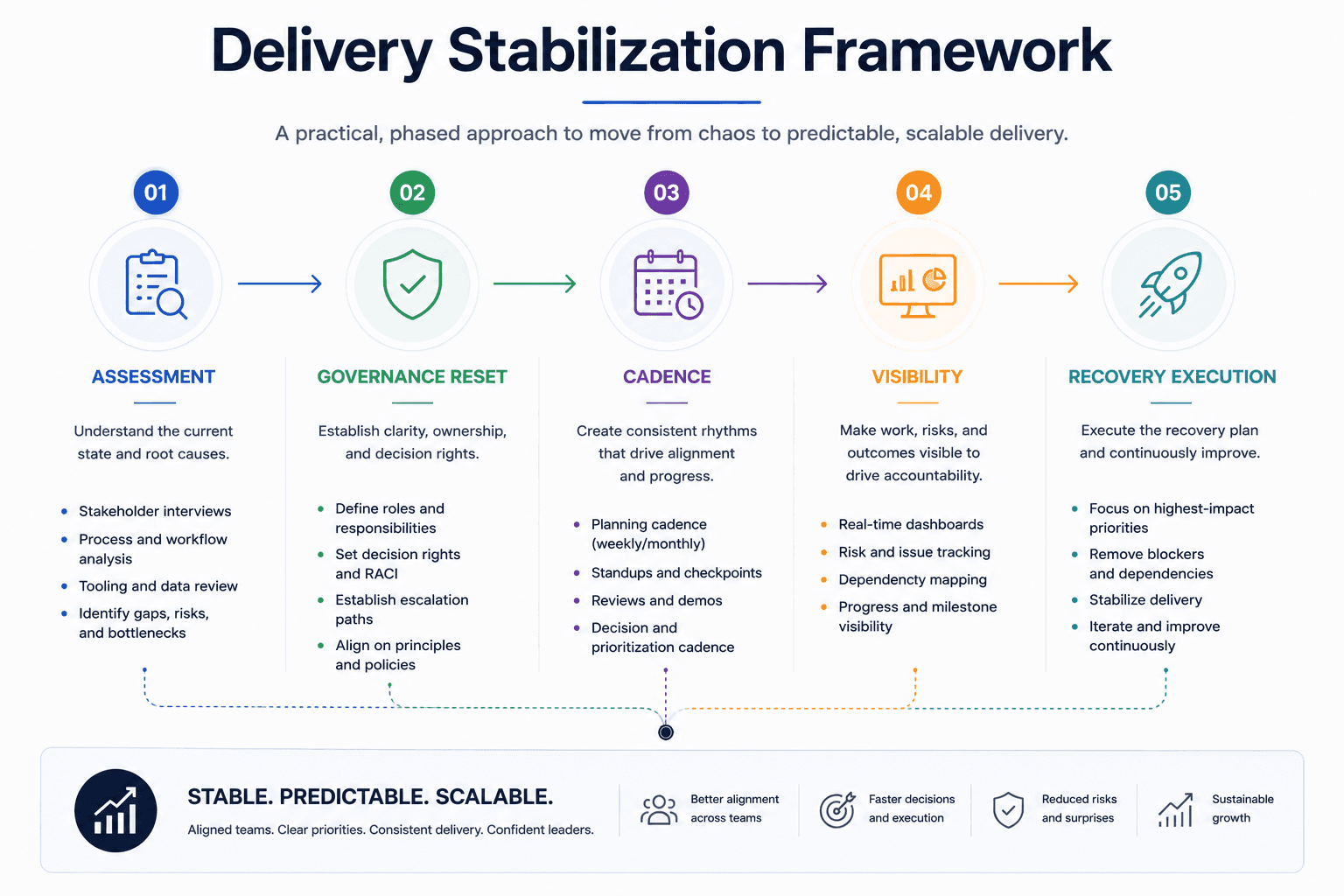
What Delivery Stabilization Actually Looks Like
Many companies assume stabilization means: more meetings, more pressure, or tighter deadlines.
In reality, effective stabilization is structured operational recovery. A strong stabilization process usually follows five stages.
1. Assessment
First, the organization needs a realistic understanding of what is actually happening.
This includes:
delivery health analysis;
roadmap review;
dependency mapping;
workload analysis;
stakeholder interviews;
process and backlog review.
The goal is clarity - not blame.
2. Governance Reset
Most unstable projects suffer from unclear operational rules.
This stage usually introduces:
ownership clarification;
escalation paths;
prioritization logic;
delivery governance;
decision-making structure.
Good governance reduces chaos immediately.
3. Cadence Stabilization
Projects lose predictability when execution rhythm breaks down.
Stabilization restores cadence through:
structured planning;
delivery reviews;
leadership syncs;
risk escalation routines;
roadmap alignment.
Predictable rhythm creates operational confidence.
4. Visibility Improvement
One of the biggest recovery accelerators is improving visibility.
Leadership needs clear answers to:
what is blocked;
what is delayed;
what threatens delivery;
what changed recently;
where intervention is needed.
Strong visibility reduces surprises.
5. Recovery Execution
Only after stabilization foundations exist should aggressive recovery begin.
At this stage:
scope becomes manageable;
priorities become clearer;
teams regain focus;
stakeholders regain confidence;
delivery forecasts become more reliable.
This is where projects usually start recovering momentum.
The Goal Is Not Perfection - It Is Control
No software delivery organization operates perfectly all the time. Fast-moving startups especially will always experience pressure, changes, and uncertainty.
The difference between stable and unstable organizations is not absence of problems. It is the ability to identify degradation early and recover in a structured way before chaos becomes systemic.
Key Takeaways
Most IT projects degrade gradually, not suddenly.
Teams often work harder as delivery health worsens.
Delivery stabilization is about restoring predictability - not increasing pressure.
Weak governance and reactive prioritization are common root causes of instability.
Early intervention dramatically improves recovery chances.
Most struggling IT projects do not need more pressure. They need operational stabilization, delivery visibility and structured execution recovery.
At Miros, we help software and AI companies stabilize delivery operations, recover slipping initiatives, and rebuild execution predictability before delivery chaos becomes systemic.

Insights
Read more articles



Questions & answers
Frequently
Asked Questions
We already have PMs. Why would we need this?
Most companies we work with already have PMs. The issue is not the people - it’s the system they operate in. Without a clear delivery structure: - PMs work differently - priorities shift constantly - decisions are unclear - delivery becomes inconsistent What we implement is a single operating model: - how projects start & planned - how they are executed - how they are tracked - how decisions are made Your PMs don’t get replaced - they become effective inside a system that works.